


Understanding the Difference Between FM and IFM: A Strategic Guide for 2026
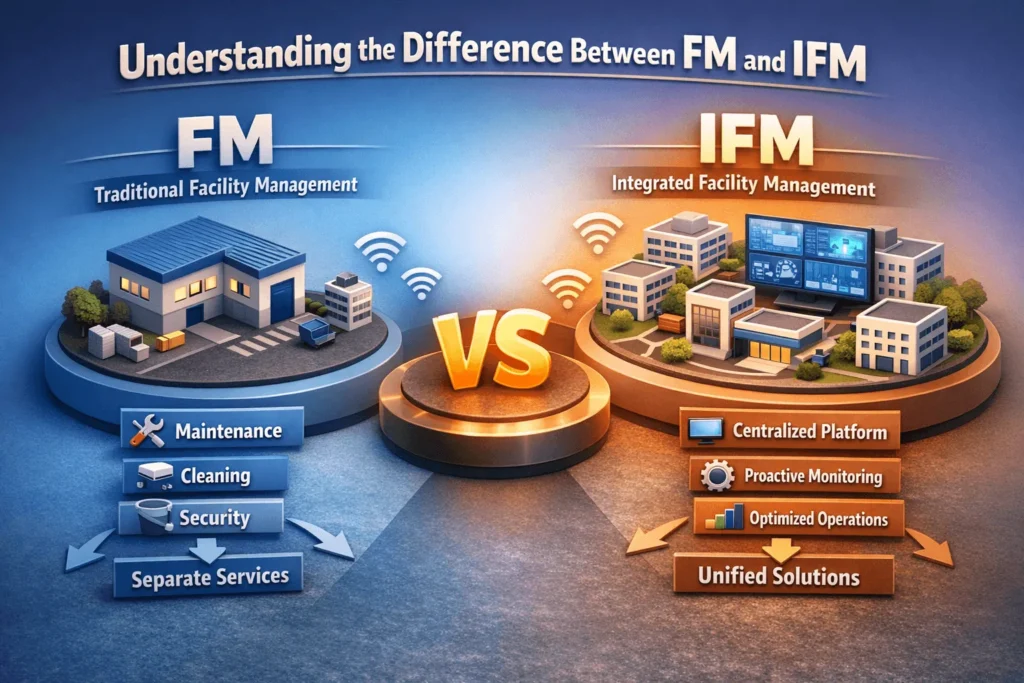
Essentially, the primary difference between FM and IFM lies in the management structure. Traditional Facility Management (FM) involves managing multiple separate vendors for different building services. In contrast, Integrated Facility Management (IFM) consolidates all services under a single provider, a single contract, and a unified technology platform.
The global landscape of building operations is changing rapidly. Consequently, businesses must choose between these two models to remain competitive. Many managers often ask about the difference between FM and IFM to optimize their budgets. While both aim to maintain facilities, their operational impact differs significantly. Understanding these nuances is essential for success in 2026.
Modern buildings are becoming more complex. Therefore, a simple maintenance approach is no longer sufficient. Today, facility management influences business continuity and sustainability. It also impacts asset lifecycle management directly. This guide explores every major difference between FM and IFM to help you decide.
1. Defining the Core: What are FM and IFM?
Before comparing them, we must define each term clearly.
Traditional Facility Management (FM): The Task-Based Approach
Traditional FM involves managing individual services separately. Usually, a company hires multiple vendors for different needs. For instance, one contractor handles cleaning while another manages security. This model is often called “multi-vendor” management. It focuses on executing specific tasks through separate contracts.
Integrated Facility Management (IFM): The Outcome-Based Approach
In contrast, IFM consolidates all efforts under one unified team. It is a strategic method that brings all building processes together. Instead of managing ten vendors, you have one dedicated partner. This partner oversees everything from plumbing to energy monitoring. This model focuses on performance and total building health.
2. 5 Critical Pillars: The Real Difference Between FM and IFM
To truly grasp the difference between FM and IFM, we must look at five key areas.
I. Contractual Structure
In traditional FM, you manage a web of independent contracts. Each vendor has its own terms and expiration dates. However, IFM uses a single, comprehensive agreement. This simplifies administration and reduces legal overhead significantly.
II. Data Management and Visibility
Data is often siloed in a multi-vendor FM model. Specifically, the cleaning contractor doesn’t share data with the HVAC technician. Consequently, you lack a complete view of your building’s performance. Conversely, IFM provides a “single source of truth.” All data flows into one central system, such as a CAFM or IWMS. This integration allows for better maintenance request management and faster decision-making.
III. Financial Impact and Cost Control
FM may seem cheaper initially due to segmented bidding. Nevertheless, hidden costs often arise from administrative duplication. IFM offers “economies of scope.” Because one provider handles multiple services, they can optimize labor and resources. Over time, this lowers the total cost of ownership.
IV. Accountability and Responsibility
Distributed accountability is a hallmark of traditional FM. If a flood occurs, the plumber might blame the security guard for a late response. This “finger-pointing” creates delays. In the IFM model, the provider takes full ownership. There is only one point of contact, which ensures higher responsiveness.
V. Scalability for Growth
Managing multiple vendors becomes a nightmare as your business grows. Expanding to three new sites means thirty new contracts. However, IFM is built for scale. An integrated partner can easily replicate processes across your entire portfolio.
3. Hard FM vs. Soft FM: How Integration Changes the Game
Facilities management is divided into two main categories: Hard and Soft services.
- Hard FM Services: These include physical assets like HVAC, plumbing, and electrical systems.
- Soft FM Services: These include people-centric tasks like cleaning, security, and landscaping.
The main difference between FM and IFM lies in how these interact. In traditional FM, these services rarely communicate. But in an IFM model, they work in harmony. For example, the security system can signal the HVAC to lower the temperature when a room is empty. This level of synergy is only possible through integration.
4. Why the Middle East is Shifting to IFM in 2026
The regional market, particularly in Qatar and the UAE, is evolving. Infrastructure is becoming more technologically advanced. Therefore, property owners are reassessing their models.
In Qatar, for example, the focus on sustainability is driving change. Integrated models make it easier to track energy consumption and carbon footprints. Organizations managing commercial towers or logistics hubs now require structured oversight. If you are operating in this region, consult a property-facility-management-qatar-guide to understand local compliance.
Furthermore, the “Smart Building” movement thrives on integration. Traditional FM struggles to manage IoT sensors and predictive analytics across multiple vendors. In contrast, IFM providers use these technologies to prevent breakdowns before they happen.
5. Decision Matrix: Is IFM Right for Your Organization?
Choosing the right model depends on your specific needs. To understand the difference between FM and IFM for your case, ask yourself:
- Portfolio Size: Do you manage multiple sites? If yes, IFM is likely better.
- Technological Maturity: Do you want to use IoT and smart systems? Integration is necessary here.
- Administrative Capacity: Do you have a large team to manage ten different vendors? If not, choose IFM to simplify your life.
- Budget Strategy: Are you focused on low monthly fees or long-term asset value? IFM excels at protecting long-term value.
While IFM is gaining momentum, traditional FM remains viable for small, standalone properties. If your building has limited system interdependence, a simple vendor model might suffice.
6. The Roadmap: How to Transition Successfully
If you decide to move toward an integrated model, follow these steps.
Step 1: The Audit Phase
First, gather all your current contracts and data. Understand your current spending and service gaps. You must know what you have before you can integrate it.
Step 2: Stakeholder Alignment
Transitioning is a major change. Therefore, you must get buy-in from your leadership and employees. Explain how the difference between FM and IFM will benefit their daily work.
Step 3: Partner Selection
Don’t just choose the cheapest provider. Look for a partner with strong technological capabilities and local expertise. Ensure they understand the regulatory framework of your specific region.
Step 4: Implementation
Switching to an IFM model usually involves a complex setup. Use software to automate workflows. This is the time to optimize your maintenance request management for maximum efficiency.
7. The Future of Facility Management in 2026
The industry is moving away from reactive “break-fix” mentalities. Instead, it is moving toward strategic partnership. The difference between FM and IFM is ultimately about vision. One is a service; the other is a strategy.
In 2026, facilities are seen as assets that drive employee well-being and ESG (Environmental, Social, and Governance) goals. Integrated Facility Management is the tool that makes these goals achievable. It provides the transparency and coordination needed for a greener, smarter future.
Experience smart property management software
Frequently Asked Questions (FAQ)
What is the primary difference between FM and IFM?
The main difference between FM and IFM is the management structure. FM uses multiple independent vendors. IFM uses a single provider for all services.
Is IFM more expensive than traditional FM?
Initially, setup costs for IFM can be higher. However, it typically leads to significant long-term savings through efficiency and reduced administrative work.
Can small businesses benefit from IFM?
Yes, but it depends on complexity. Small businesses with high-tech needs or multiple locations often find IFM very beneficial.
How does IFM improve building sustainability?
IFM centralizes energy and waste data. This allows for coordinated initiatives that are impossible to manage with separate vendors.
